The Busywork Trap: When Activity Hides an Unclear Offer
The busywork trap can crowd out useful work. Review what your tasks change for customers, then choose a clear next action without abandoning essential upkeep.
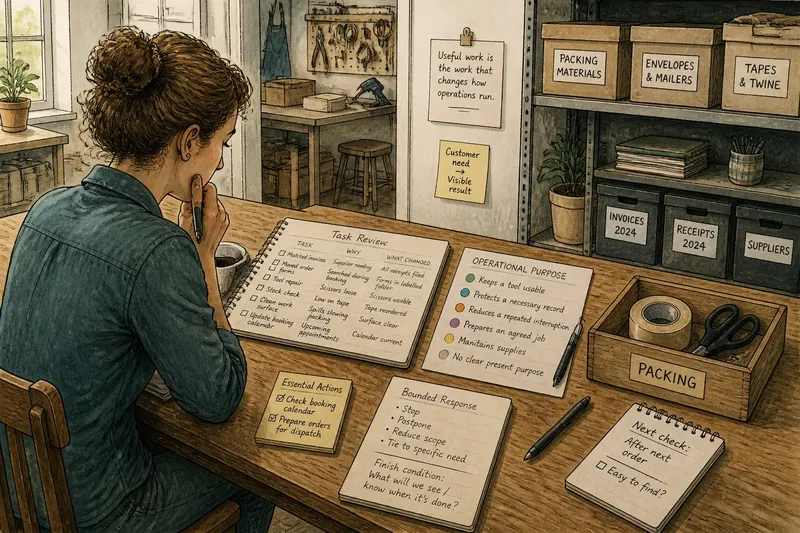
You shut your laptop after adjusting a logo, sorting receipts and rewriting tomorrow’s task list. The busywork trap is easy to miss when activity fills the day but leaves no visible change in how the work runs. A task review can help you spot which jobs support current operations and which have become motion without a clear purpose.
This is not a case for abandoning organisation. Records, tools and routines help a small venture operate responsibly. The useful question is whether each task addresses a present need, and what observable result would tell you it is done.
Review tasks by the operational change they make
Start with the work you actually did over the past few working days. In a notebook, spreadsheet or paper calendar, list concrete actions rather than broad labels: “matched supplier invoices to receipts” is clearer than “admin”; “replaced the worn label on the storage box” is clearer than “tidying”.
Add what prompted each task and what changed afterwards. For example, “moved the current order forms into a labelled folder after searching for one during a booking” gives you a reason and an observable result. “Worked on files” does not.
Include small interruptions as well as planned jobs. A quick stock check or tool repair may take little time but prevent a larger disruption. You do not need to record every moment; aim for a useful picture of what occupied your attention.
Sort work by its current operational purpose
For each task, ask what operational need it serves. Does it keep a tool usable, make a process easier to repeat, preserve a necessary record, or address a problem that has already occurred? Name the connection plainly rather than treating every organised-looking activity as valuable.
Use these categories as prompts, not as a scorecard:
- Keeps a tool usable: Check whether the tool is damaged, missing or hard to use; if it is, repair or replace only what is needed, and if it is not, leave it alone.
- Protects a necessary record: Check whether a document is required for a current business or personal obligation; if it is, file it in an appropriate, secure place, and if it is not, avoid creating extra filing work without a reason.
- Reduces a repeated interruption: Check whether the same problem has interrupted work more than once; if it has, make a small process change and watch whether the interruption recurs, and if it has not, note the issue before redesigning the routine.
- Prepares an agreed job: Check whether a customer commitment depends on the task; if it does, complete the necessary preparation, and if it does not, keep it off the urgent list until a real need appears.
- Maintains supplies: Check whether a material is missing or unsuitable for planned work; if it is, update the supply note and choose an appropriate alternative, and if it is not, stop rearranging or recounting it.
- Has no clear present purpose: Check whether you can name a current operational need and a visible result; if you can, define the smallest useful action, and if you cannot, postpone or drop the task rather than letting it occupy the day.
Some useful work happens out of customers’ sight. Keeping receipts orderly, maintaining a booking calendar or cleaning a shared work surface may support reliable operations. The point is not to make every task customer-facing; it is to distinguish necessary upkeep from open-ended polishing.
Choose a bounded response to low-purpose work
When a task has no clear present purpose, you can stop it, postpone it, reduce its scope or tie it to a specific operational need. A bounded task includes a clear finish condition. Instead of “keep improving the spreadsheet”, decide which information must be available and check whether the existing sheet provides it.
Imagine a maker who has spent several evenings rearranging the labels on storage boxes. Their starting point is a cupboard where the frequently used packing tape and scissors are difficult to locate. They first pause the cosmetic relabelling, then place those two tools in one reachable tray and mark the tray “packing”. They leave the other labels unchanged and check the next time an order is prepared. The resulting decision is straightforward: if the tools are easy to find, keep the small change; if the tray creates clutter or does not solve the search, try a different place rather than redesigning every label.
The example is about matching effort to an observed problem, not adopting a particular storage system. A small adjustment is easier to assess than a wholesale reorganisation whose benefit is unclear.
Protect time for essential operational work
Once you have reviewed the list, reserve time for the operational tasks that would otherwise be displaced. Put a specific action in the calendar before optional refinements crowd it out. “Check that the booking calendar shows confirmed appointments” is easier to begin than “sort out admin”.
Keep the action proportionate. If a current process works, there may be no need to replace the app, redesign the folder structure or buy new equipment. Use tools you already have, such as a paper list, a calendar app or a labelled envelope, unless a concrete problem calls for something else.
Unexpected work and caring responsibilities can alter a day’s plan. Record what took priority and return to the review when practical. A useful routine should help you make decisions, not create another standard you feel obliged to meet.
Check what changed before doing more
At the end of a work block, note the result in observable terms: a missing receipt is filed, a tool is usable again, or a recurring handover has a clear place in the calendar. These signs can guide your next decision without turning routine work into a set of performance figures.
If a change does not help, do not automatically expand it into a larger project. Consider whether the original problem still exists, whether the action addressed it, and whether another small adjustment is more sensible. Keeping the next decision narrow makes it easier to tell useful maintenance from more busywork.
Which tasks deserve attention now?
Is routine administration always busywork?
No. Records, booking routines and supply checks can support dependable operations. Keep a task if it meets a real need, and reconsider it if it has become repetitive tidying without a useful result.
What if the reason for a task is uncertain?
Write down what prompted it and what visible result you expect. If neither is clear, postpone the task while you look for a concrete operational need.
Should you stop work that happens behind the scenes?
Not automatically. Some internal tasks keep tools, records or agreed work in order. Judge them by their purpose and scope, rather than by whether customers can see them.
How often should you review your task list?
Review it when you notice that tasks are multiplying without resolving a problem, or when a change in responsibilities affects your routine. Keep the review brief enough that it does not become another project.
Keep maintenance purposeful and proportionate
A task earns its place through the need it serves, not how polished it makes the operation appear. If the busywork trap starts to take over, look at the work already on your list, identify one current operational problem and choose the smallest action with a visible result. That gives you a practical basis for deciding what to maintain, change or leave for later.
Before adding a new routine, consider how you will know it is helping. A simple answer, such as “the next person can find the shared order form”, is often enough to keep useful upkeep focused.