Conversation or Observation: Two Ways to Notice Customer Needs
Conversation or observation helps a small business spot customer needs from both what people say and what they actually do, before shaping an idea.

You ask a customer how they organise receipts, and they say they keep them in a folder. Later, you see them searching through a tote bag at the counter. The gap between those moments is useful: conversation or observation can reveal different parts of the same task.
For a small business deciding what to offer, noticing a need means understanding where a task becomes awkward, slow, confusing or easy to abandon. Asking people about a task reveals their account of it; watching them approach it reveals choices and workarounds that may be hard to describe. Neither method gives a complete picture on its own.
Conversation reveals how people explain a task
A conversation is useful when you need to learn what someone believes they are trying to do, what matters to them, and how they describe the obstacles. A person might say that booking a local repair service is difficult because they cannot tell which details to provide. That account points towards uncertainty about the process, rather than simply a shortage of repairers.
Ask about a recent, specific occasion rather than inviting guesses about a future product. “Tell me about the last time you tried to arrange a repair” is more revealing than “Would you use an app for repairs?” The first prompt helps the person recall the sequence, decisions and frustrations. The second asks them to judge an idea they may never encounter in practice.
Useful prompts are open, neutral and grounded in events:
- What were you trying to get done?
- What did you do first?
- Where did you pause or change course?
- What did you do when that happened?
- What mattered most in choosing what to do next?
Listen for the person’s own words, not only the conclusion. “It was a faff” is a signal to ask what made it so: perhaps the form asked for information they did not have, or perhaps they were unsure who would receive it. The details can lead to different ideas, so avoid translating a broad complaint straight into a product feature.
Observation reveals the task as it unfolds
Observation means paying attention to the steps, objects and decisions involved in a task, with the person’s permission. It can show what someone reaches for, skips, repeats, checks or does instead. These actions matter because people may not remember every small decision when describing an experience later.
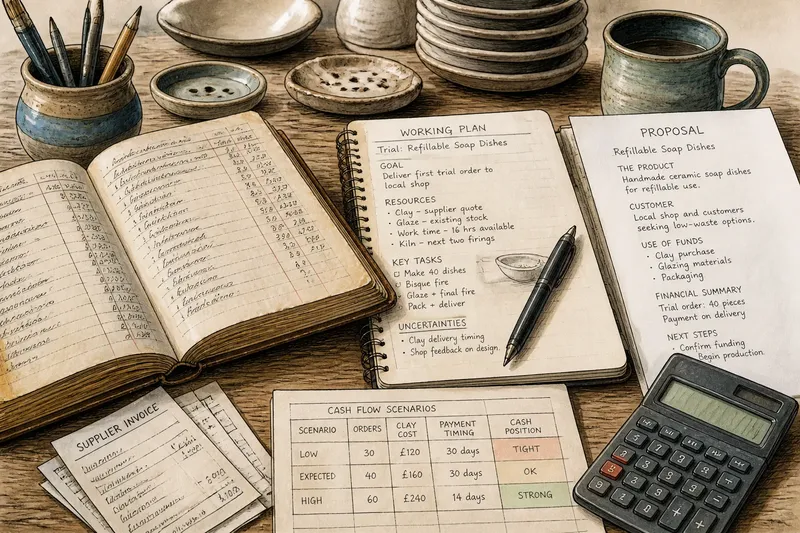
Suppose someone says they prepare orders using a notebook. Watching the process might show that they copy the same customer details from a message into the notebook, then back onto a parcel label. The conversation tells you that the notebook is part of their system; observation makes the repeated copying visible. That may suggest a need around transferring information, not a general need for a different notebook.
Keep the setting as ordinary as possible. If you are learning about how a market trader restocks packaging, observe during a usual preparation period rather than asking them to perform a staged demonstration. Stay unobtrusive, take brief notes about actions and context, and ask for clarification afterwards. A person who knows they are being watched may behave differently, so treat a single observation as a clue rather than a complete account.
Observation also has limits. You can see that a customer abandons a form, but not know whether the reason is confusing wording, lack of time, privacy concerns or something unrelated. Visible behaviour shows what happened, not necessarily why. A short follow-up question can help, provided it does not turn the moment into a defence of the person’s choices.
Use both methods to separate accounts from clues
Conversation and observation are complementary, not rival techniques. Conversation gives meaning and context; observation provides details about behaviour and the setting. When they point in different directions, do not decide too quickly that one is right. The difference may reveal that people have adapted to an inconvenience so thoroughly that it no longer comes to mind when asked.
Imagine you are considering a collection service for a neighbourhood repair shop. In a conversation, several customers describe carrying small items across town as inconvenient. With permission, you watch one customer drop off a broken lamp and notice that they first call to check whether the shop handles that model, then wrap the lamp in a towel for the journey. The idea may need to address uncertainty about eligibility as well as transport. A follow-up conversation can check whether the call and wrapping are common concerns or particular to that customer.
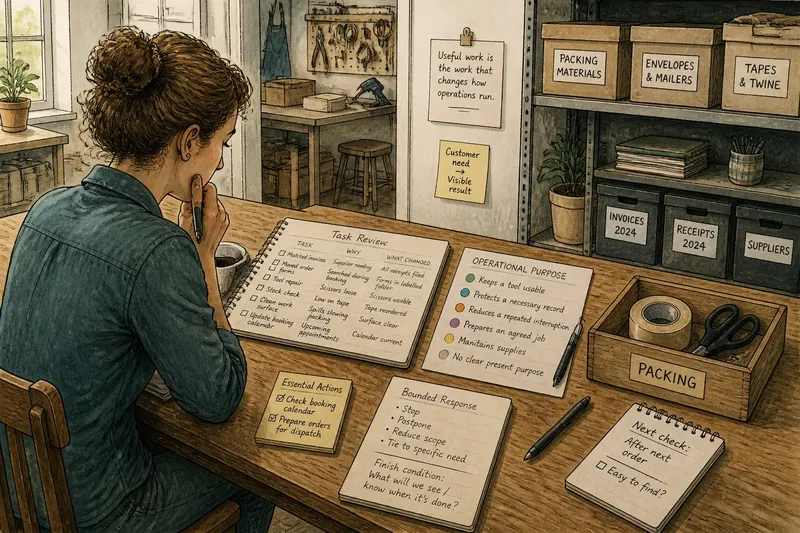
Keep notes in two separate columns: “said” and “did”. Record exact phrases in the first and observable actions in the second. Add the context, such as where the task happened and what materials were involved. This simple separation makes it harder to mistake your interpretation for someone else’s explanation.
Then look for recurring friction, not just recurring requests. A person may ask for a faster booking system, while the observable difficulty is finding a suitable time slot. Another may ask for more product choices but repeatedly leave when the available options are hard to compare. Those distinctions help you shape a small, testable idea around the task rather than copying a suggested solution uncritically.
Choose a method that fits the question
Start by naming what you do not yet understand. If the uncertainty is about a person’s priorities, reasons or language, a conversation is a sensible first move. If it concerns sequence, physical handling or decisions made in the moment, observation may reveal more. If both are unclear, begin with a short conversation, observe a real task where practical, then ask a few questions about what you saw.
For a small venture, useful settings can be close at hand: a stallholder preparing stock, a neighbour arranging a collection, or a regular customer using a booking page. Ask permission, explain what you hope to learn, and make it easy for someone to decline. Avoid collecting personal details that are not needed to understand the task.
Choose a narrow task rather than trying to understand a person’s entire life. “How do you decide which refill bottle to buy?” is manageable; “What do you need from local shops?” is too broad to guide a useful observation. A focused question also makes it easier to notice what evidence would change your current idea.
Which approach should you use first?
Can a conversation alone reveal a customer need?
It can reveal a person’s priorities, remembered difficulties and the words they use for a task. It may miss small workarounds or details they no longer think to mention, so treat the account as a starting point.
What should I watch during an observation?
Notice the order of actions, pauses, repeated work, tools used and moments when someone changes course. Describe what happened before deciding what it means; “opened three messages to find the address” is an observation, while “the customer needs an app” is an interpretation.
How do I ask questions without steering the answer?
Ask about a recent occasion and use neutral prompts such as “What happened next?” Avoid suggesting a solution or praising a particular answer, since that can encourage agreement rather than a clear account.
What if what someone says differs from what they do?
Record both and look for a reason to ask a respectful follow-up. The difference may reflect memory, habit or the conditions of that particular moment, so do not assume dishonesty or treat one instance as a rule.
Turn what you notice into a careful next move
After gathering notes, write one plain sentence describing the task and its point of friction: “People who bring an item for repair need to know whether the shop can handle it before making the journey.” Keep the sentence about the need, not a proposed feature. Then consider a modest response, such as making the shop’s accepted repair types easier to check, and ask whether that addresses the observed uncertainty.
Conversation or observation is most useful when it helps you make a better next decision, not when it produces a pile of notes. Keep the evidence modest, check an interpretation with the people involved where appropriate, and be willing to revise the idea. A small business can often learn enough from one well-chosen task to decide what to ask or notice next.