Before the Spreadsheet: A Short History of the Business Plan
The history of the business plan runs from merchant records to modern proposals, showing small ventures how to choose a format that suits the decision.
A shopkeeper opening a ledger to record a customer’s order is doing something simpler than writing a business plan, but the two share a practical concern: making an undertaking clear enough to act on. The history of the business plan is not a straight line from ancient trade to a standard document. It is better understood through particular records and the changing purposes they served.
For a small enterprise, that history offers a useful distinction. A record of a deal, an internal plan and a proposal for a lender may all describe business activity, but they answer different questions. Their formats should not be treated as interchangeable.
Merchant records documented particular transactions
Medieval Italian merchants used account books to record transactions, debts and goods. The surviving ledger of the Datini merchant Francesco di Marco Datini, whose business operated from Prato in the late fourteenth and early fifteenth centuries, is a concrete example of commercial record-keeping. Such books helped track business dealings; they were not modern business plans, and calling them that would blur an important difference.
A ledger records what has happened or what is owed. A plan describes an intended course of action. The first can help an owner understand available resources and obligations; the second can set out a proposal before work begins. Both put business information into a form that other people, or the owner at a later date, can consult.
Printed forms and management theory gave planning a new role
In the nineteenth century, railways and other large enterprises required coordination across extensive operations. Their managers used budgets, schedules and reports to organise work and account for resources. These tools were not necessarily business plans in the present sense, but they show how planning became part of managing an organisation rather than simply documenting a transaction.
In the early twentieth century, management writers such as Henri Fayol discussed planning as one part of administrative work. This idea concerned the organisation’s direction and activities, not a fixed template for a new venture. The practical problem was how to connect an aim with the people, materials and decisions needed to pursue it.
For a small maker, the distinction still matters. A production schedule can organise next month’s work without explaining the business to a bank. A written proposal can explain a new product to a possible stockist without serving as a day-to-day record of every order.
Loans and investment encouraged the modern proposal
As lending and investment became familiar ways to finance enterprises, owners had reason to explain what they intended to do with other people’s money. A proposal could describe the product or service, likely customers, operating needs and use of funds. The recipient could then assess the request in light of the information provided.
This does not mean that one universal business-plan format emerged at a single moment. Requirements vary by purpose and recipient. A bank may ask for information relevant to repayment, while a prospective partner may want to understand responsibilities and how the venture will operate.
A polished proposal has a persuasive purpose, but it should not disguise uncertainty. If a claim rests on an estimate rather than an order, say so. For the owner’s own decisions, a less polished working plan may be more useful because it can keep unanswered questions visible.
Spreadsheets made assumptions easier to connect
Electronic spreadsheets gave businesses a convenient way to link entries. Change an assumed number of orders or a material cost, and related calculations can be updated. That makes it easier to compare possible outcomes, but it does not make an assumption reliable merely because it appears in a formula.
A spreadsheet is most useful when it answers a defined question. A maker might use one to see whether buying packaging before receiving customer payments would create a cash pinch. A notebook may be enough to track supplier replies or the tasks needed for a small batch. Choose the format that makes the decision clearer, rather than building a model simply because the software allows it.
Keep records, plans and proposals distinct
These three documents serve different purposes:
- A record captures activity or commitments, such as orders in a ledger or receipts filed for bookkeeping.
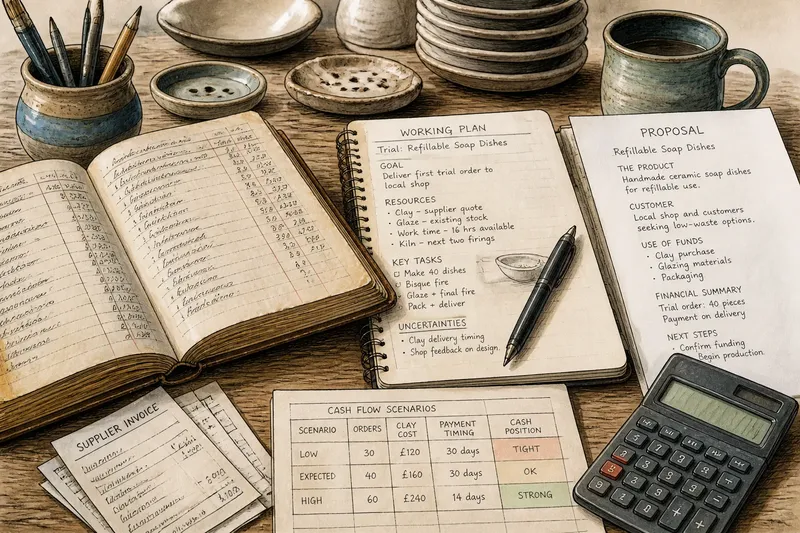
- A working plan sets out the intended action, the resources needed and the main uncertainties for the owner or team.
- A proposal explains a request or opportunity to an outside reader, such as a lender, funder or potential partner.
They can draw on some of the same information, but they should not be collapsed into one document by default. For example, a supplier invoice belongs in the records; the decision to order more stock belongs in the working plan; a request for funds may need a separate proposal.
How does a business plan differ from a ledger?
What does a business plan explain?
It describes an intended course of action: what the venture offers, who it hopes to serve, what resources the work requires and which assumptions remain uncertain. It is about choices under consideration, not a complete record of past transactions.
What does a ledger record?
A ledger organises financial transactions and balances. It supports bookkeeping and later review, but it does not by itself explain why the owner chose a particular product or what they intend to do next.
Does a small business need both?
Many small ventures need some form of transaction record, while a written plan is useful when a decision involves several connected commitments. The appropriate level of detail depends on the work and any requirements set by a lender, funder or other recipient.
Can a spreadsheet replace a business plan?
A spreadsheet can support calculations, but it may not explain the offer, responsibilities or reasoning behind a decision. Pair it with a short written note when a reader needs that context.
A worked example shows why the distinction matters
Say a potter has a confirmed request from a local shop for a trial of refillable soap dishes. The starting information is a written order for unglazed pieces, a supplier quote for clay, the potter’s available work time and an existing ledger of past purchases.
- Keep the order in the records. Enter the customer commitment and expected payment in the bookkeeping system; the observable result is that the transaction can be checked alongside other orders.
- Use a working plan for production. List the unglazed finish, clay required, packaging still to source and the work sessions available. If the materials and time appear sufficient, proceed with the batch; if packaging is unresolved, ask the shop what it will accept before committing to that choice.
- Use a spreadsheet only for a cash question. Enter the quoted material cost and the expected payment timing. If the sheet indicates the purchase would leave too little cash for already-planned obligations, ask the supplier about a smaller order or delay the purchase; otherwise, retain the proposed order and keep the quote with the records.
The example’s figures and circumstances are invented. Its point is the division of labour: the ledger preserves what is committed, the plan guides the work, and the spreadsheet helps examine a specific financial choice. None of those tools can settle a question that depends on missing information, such as whether the shop will accept different packaging.
Choose the document that answers the next decision
The history of the business plan is a history of changing business needs, not a story of one document gradually becoming perfect. Merchant ledgers, management schedules, proposals and spreadsheets each address different problems. For a small enterprise, the useful question is not which format looks most professional, but which one lets the intended reader distinguish what has happened, what is proposed and what remains uncertain.
If a lender or funder requests a particular format, follow its instructions and seek qualified financial or accounting advice where the decision requires it. For internal use, keep the record of transactions separate from the plan for future work. That simple separation makes it easier to check a past commitment without mistaking it for a promise about what comes next.